Financial services organizations operate in an environment where regulations, products, customer expectations, and internal policies change constantly. For Learning and Development (L&D) teams, keeping training content accurate and relevant across departments, roles, and geographies is an ongoing challenge.
Traditional content development often involves multiple rounds of research, subject matter expert (SME) consultations, scripting, reviews, and localization. By the time a course is ready, some of its information may already be out of date.
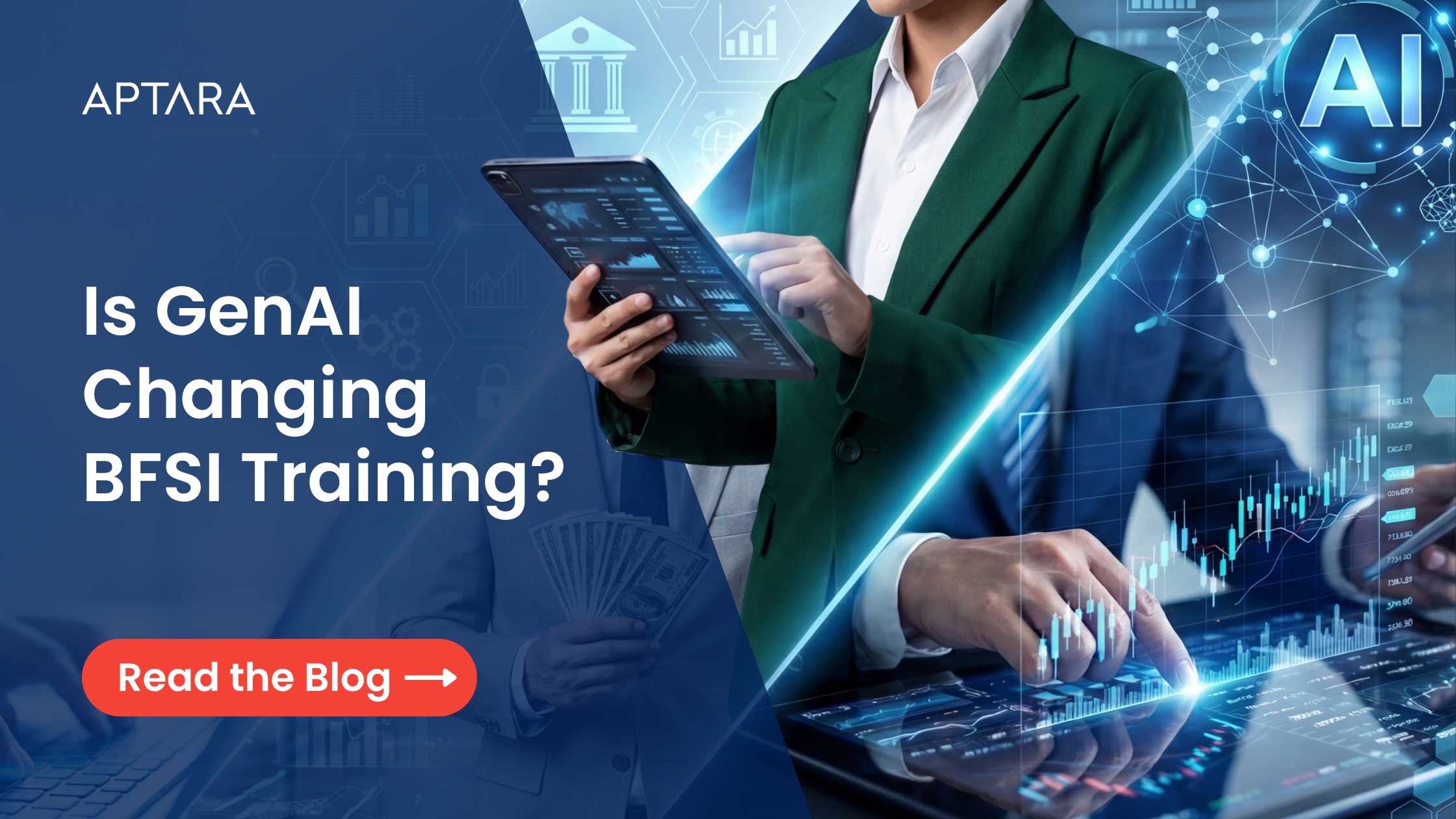
Generative AI offers a way to accelerate this process. It can help L&D teams turn complex information into structured learning materials, generate realistic scenarios, and develop content variations faster. In a highly regulated sector, however, speed must go hand in hand with accuracy and human oversight.
Where GenAI Fits into the Training Content Lifecycle
GenAI can support several stages of training development, reducing repetitive work and helping teams move from source material to learning experiences more efficiently.
- Ideation: Identify learning objectives and suggest course structures based on business requirements.
- Scripting: Convert lengthy policy documents and technical information into learner-friendly explanations.
- Storyboarding: Generate scene descriptions, dialogues, and visual suggestions for eLearning modules.
- Assessments: Draft knowledge checks, quizzes, and scenario-based questions.
- Localization: Create initial translations and adapt examples for different markets, subject to language and cultural reviews.
High-Impact GenAI Use Cases in BFSI
Some applications are particularly relevant to banking, financial services, and insurance (BFSI).
1. Policy-to-course conversion: A bank can use an approved anti-money laundering (AML) policy as the source for a course outline, key learning points, and assessment questions. Compliance specialists then verify that the generated material reflects the actual requirements.
2. Scenario generation: GenAI can create variations of customer interactions involving suspicious transactions, identity verification, fraud reporting, or investment suitability. Employees can practice responding to different situations without exposing real customer information.
3. Quiz creation: Existing training material can serve as the basis for multiple-choice questions, knowledge checks, and role-specific assessments.
4. Multilingual training: Initial translations and localized examples can help organizations prepare learning content for geographically distributed workforces. Human reviewers remain essential for terminology, regulatory differences, and cultural accuracy.
Speed and Scale: What Changes for L&D Teams
GenAI can reduce the time spent on first drafts, repetitive content development, assessment variations, and initial translations. L&D teams can also create role-specific versions of a course for relationship managers, customer service representatives, and compliance teams from a common source.
However, faster production does not automatically mean better learning. Instructional design, stakeholder reviews, accessibility checks, and learner testing still require time and expertise. The real benefit is that L&D professionals can spend more time on learning outcomes and less on repetitive production tasks.
Why Human Expertise Remains Central
AI can generate a draft, but it cannot independently determine whether a learning intervention meets an organization’s regulatory obligations or business objectives. In financial services, a single outdated reference or misread policy can turn a training gap into a compliance risk.
That is why human expertise must sit at every stage of the workflow:
- Subject matter experts (SMEs) verify technical accuracy and confirm that examples reflect real business practice.
- Instructional designers structure content into meaningful learning experiences with clear objectives, realistic practice, and well-constructed assessments.
- Compliance reviewers validate that every statement aligns with current regulations and approved internal policies.
Together, these roles turn AI-generated drafts into training content that organizations can trust and defend in an audit.
Getting Started: A Phased Adoption Roadmap
Financial institutions can begin with low-risk applications, such as summarizing approved documents or generating draft quiz questions. Next, they can pilot AI-assisted scripting and scenario development for selected training programs. Once review processes and governance controls are established, they can expand to localization and larger content initiatives.
Conclusion
Generative AI is changing how financial services organizations approach training content creation, but the organizations that benefit most won’t be the ones that adopt it fastest. They will be the ones that adopt it with the right safeguards.
The pattern is consistent: start with approved source content, use GenAI to speed up drafts, scenarios, and assessment items, and keep SMEs, instructional designers, and compliance reviewers in control of what reaches learners. Speed matters, but in a regulated sector, trust matters more.
Your next step: choose one low-risk training topic, such as a policy summary or a set of knowledge-check questions. Run it through a review-first workflow, and measure what changes in development time, review cycles, and update turnaround.