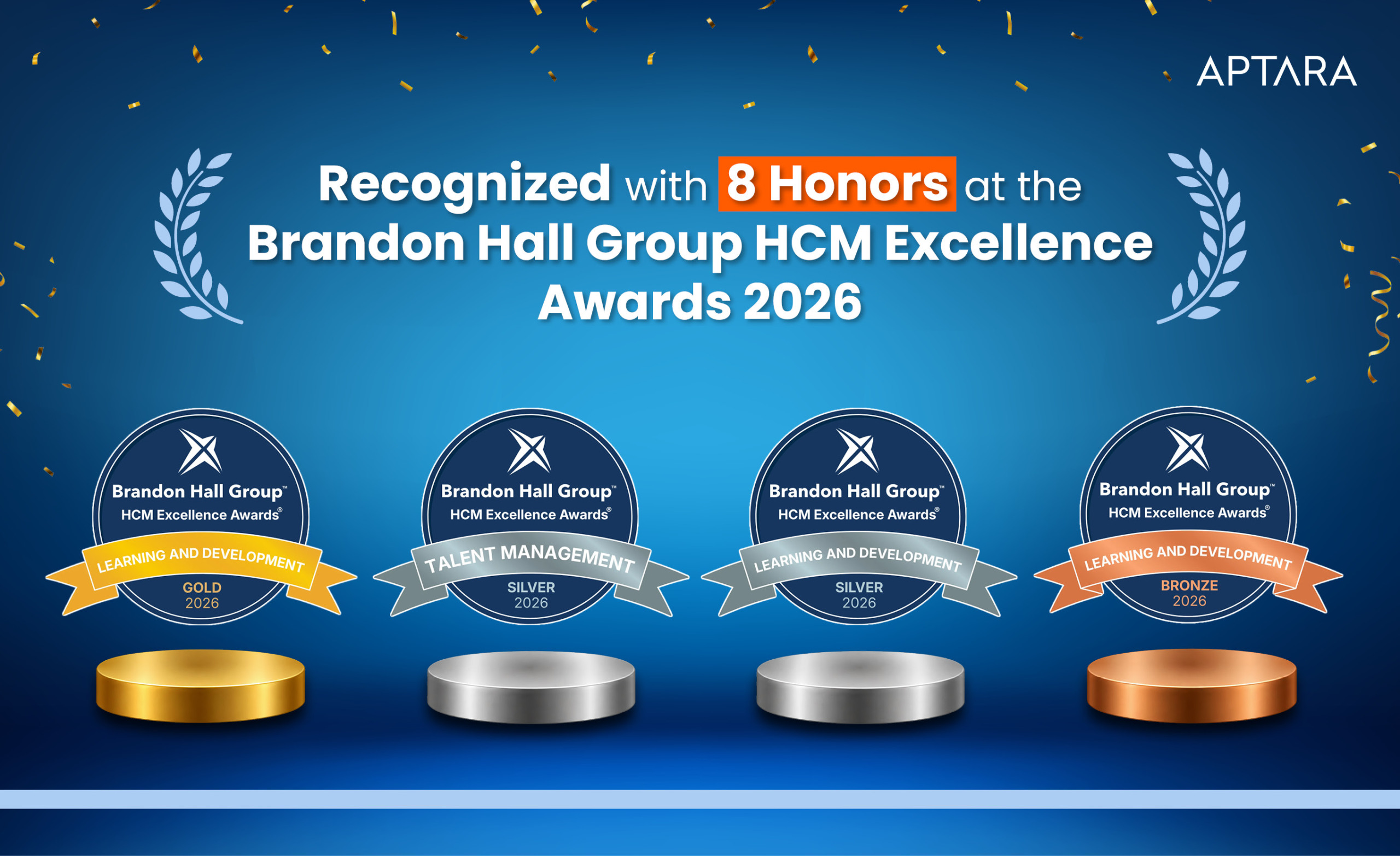
Chantilly, VA – August 17, 2026 – Aptara has secured eight recognitions, one Gold, three Silver, and four Bronze, in the 2026 Brandon Hall Group™ HCM Excellence Awards® for Learning and Development and Talent Management.
The awards recognize Aptara’s work across compliance training, custom content, performance management, video-based learning, learning strategy, performance support, and blended learning, highlighting its ability to develop learning solutions that address complex talent needs and support organizational performance.
Organizations today face growing demands to equip employees with relevant skills, meet compliance requirements, improve performance, and deliver learning experiences that work across diverse audiences and environments.
Aptara works with organizations to address these challenges through purpose-built learning and performance solutions that combine instructional expertise, technology, engaging content, and strategic design.
The recognized solutions demonstrate Aptara’s approach to creating learning experiences that are tailored to specific business and learner requirements rather than relying on one-size-fits-all approaches.
From compliance and performance management to custom content and talent management, Aptara brings together strategy, design, content development, and technology to create experiences that are relevant, accessible, and aligned with organizational objectives.
“We are honored to receive eight recognitions from Brandon Hall Group,” said Mike Stacy, Global Enterprise President at Aptara. “This recognition reflects the commitment of our teams and clients to solving real learning and talent management challenges with thoughtful, innovative approaches. We are proud of the people behind these achievements and the work they do to create learning experiences that support both learner needs and business goals.”
Aptara’s 2026 Brandon Hall Group Recognitions
Gold Award
- Best Compliance Training
Silver Awards
Learning & Development
- Best Custom Content
- Best Use of Video for Learning
Talent Management
- Best Performance Management
Bronze Awards
- Best Compliance Training
- Best Learning Strategy
- Best Use of Performance Support
- Best Use of Blended Learning
The Brandon Hall Group HCM Excellence Awards recognize organizations that demonstrate outstanding achievement in human capital management. Entries are evaluated based on criteria including business need and opportunity, program design, functionality, innovation, user experience, and measurable results.
Aptara’s eight recognitions reflect the breadth of its L&D and Talent Management capabilities and its continued focus on connecting learning strategy with practical workforce outcomes. The awards also recognize the collaborative efforts of Aptara’s teams and clients in developing solutions designed around specific organizational priorities, learner requirements, and performance objectives.
“The HCM Excellence Awards have become the most recognized benchmark for excellence in human capital management because organizations know they are earned, not given. Every winning program has demonstrated measurable impact, innovation, and execution through one of the industry’s most rigorous evaluation processes. We are proud to recognize the organizations setting the standard for the future of work,” said Mike Cooke, CEO, Brandon Hall Group.
About Brandon Hall Group™
Brandon Hall Group™ is the only professional development company that offers data, research, insights and certification to Learning and Talent executives and organizations. The best minds in Human Capital Management (HCM) choose Brandon Hall Group™ to help them create future-proof employee development plans for the new era.
About Aptara
Aptara enriches digital content and learning for every platform and device, powering end-to-end content lifecycle production and breakthrough digital learning products. Trusted by the world’s largest publishers and Fortune 1000 enterprises, Aptara’s 10,000+ professional team steers content innovation for a global client base. Founded in 1988 and headquartered in the US, Aptara remains committed to delivering content how, when, and where it matters.